
The permissionless
AI architecture.
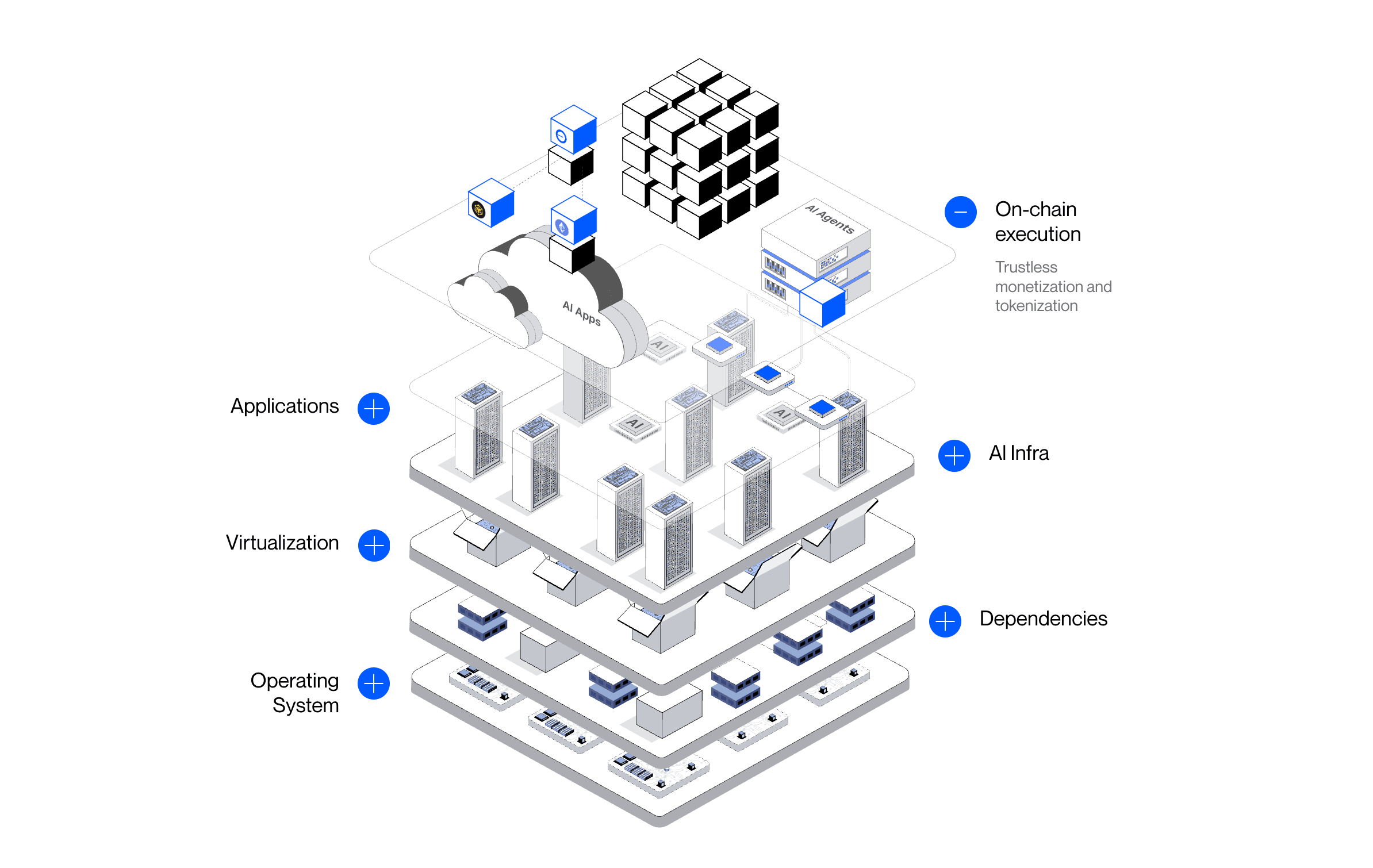
Eight interoperable layers turn independent hardware, tokenized credits, and open weights into a global compute fabric. No cloud monopoly. No jurisdictional gatekeeper.
Eight layers, one permissionless stack.
Access & Developer Layer
- X Studio, SDKs, CLI, and OpenX Search.
- Entry point for creators and operators: wallet connect, project setup, model import, dataset linking, deployment presets, monitoring, and team permissions.
- OpenX Search lets users find and compare servers across the global fleet.
Resource & Provider Layer
- Independent operators run Xnodes.
- Each Xnode advertises hardware profiles, location, bandwidth, and availability.
- Providers register resources, publish proofs of health, and receive jobs through the scheduler.
- Storage backends and fast networks sit here as first-class resources.
Tokenization & Metering Layer
- Compute becomes liquid through tGPU and tCPU credits.
- Credits are minted against verified capacity and burned on use.
- A metering module records usage with cryptographic receipts.
- Receipts back settlement, refunds, and reputation - turning raw infrastructure into a programmable asset.
Orchestration & Price Engine
- The scheduler matches jobs to Xnodes based on price, latency, and policy.
- The global price engine discovers real-time GPU costs and routes workloads to the best regions.
- Supports spot-style placement, reserved capacity, and service level guarantees.
- Autoscaling, failover, and live migrations are handled here.
Execution Runtime Layer
- X Engine runs training, fine-tuning, and inference inside reproducible containers.
- Supports agent runtimes, function calling, streaming, and multi-model graphs.
- Workloads are launched wallet to wallet without central servers.
- Geographic routing ensures requests land close to users.
Intelligence Registry Layer
- Models, datasets, prompts, and agents are tokenized as on-chain assets.
- Versioning, provenance, capability tags, and licensing terms are recorded.
- Composability lets apps reuse and remix assets while preserving credit and enforcing royalties.
Commerce & Settlement Layer
- Subscriptions, usage-based billing, and revenue share run through smart contracts.
- Payments clear in OPENX and accepted stable assets.
- Royalties split automatically to owners and collaborators.
- Cross-chain settlement is available for Base, BNB, and Solana through audited bridges and messaging.
Trust & Governance Layer
- Staking, slashing, proofs of work integrity, and provider reputation maintain network quality.
- Neutrality rules prevent jurisdictional capture.
- The DAO controls upgrades, treasury programs, and incentive design.
- Burn-to-vote aligns influence with long-term commitment.
A modular microservices framework for AI.
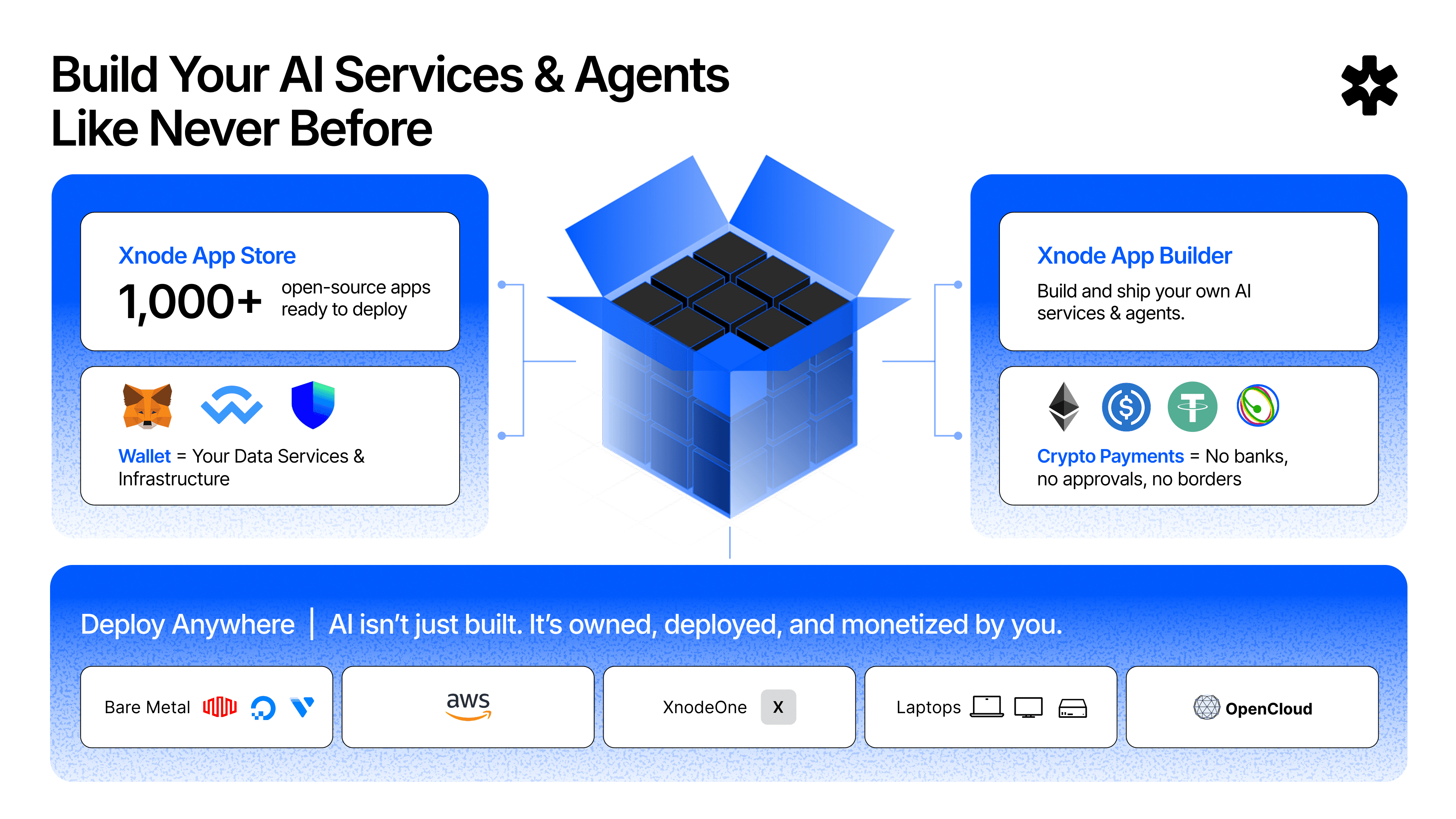
Xnode streamlines AI development by abstracting complex tasks into isolated, containerized services - designed for performance, scalability, and reliability.
Modular Design
Break AI workflows into independent services (data processing, inference) for targeted updates and easier maintenance.
Containerization
Each service runs in a self-contained environment, ensuring consistent deployments and resilience against failures.
Dynamic Scalability
Scale individual components on demand to match workload requirements - maximizing resource efficiency.
Seamless Integration
Built to integrate with the rest of the platform, including xnodeOS for declarative, reproducible environments.
Built on XnodeOS.
Global by default.
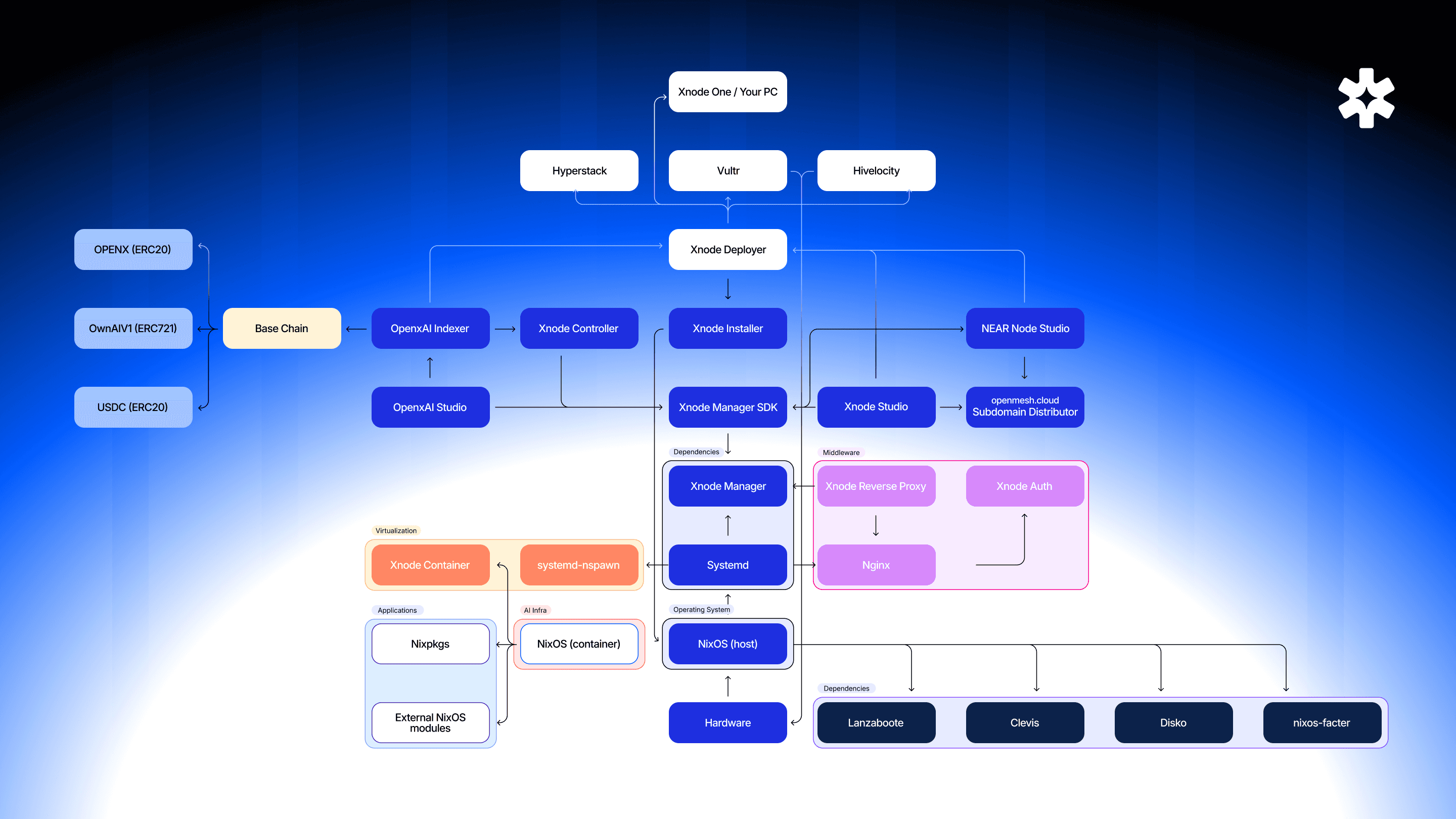
OpenX Network is built on XnodeOS, a declarative NixOS-based operating system that turns any hardware or cloud server into a secure, containerized compute node.
Each node is managed through the Xnode Manager API, authenticated with Ethereum signatures, and connected via a reverse proxy and subdomain distributor - forming a global, permissionless compute fabric.
On this network, AI workloads are deployed through X Studio, which mints tokenized ownership of services and binds them to on-chain payments and governance.
X Engine
Runs training and inference across the network.
Playground
Enables rapid testing of models, prompts, and agents.
Marketplace
Exposes models, datasets, and agents as tradeable assets.
This architecture is disruptive because it fuses decentralized infrastructure with programmable token economics - removing cloud monopolies, bank rails, and jurisdictional limits - allowing anyone to launch and monetize AI globally in minutes.
Deploy an Xnode. Run a workload. Own the outputs.
Explore the developer surface, or read the full protocol docs to see how each layer composes into a permissionless AI stack.